The New Competitive Advantage
In today’s fast-moving market, businesses that make decisions based on solid data consistently outperform those that rely on intuition alone. However, raw data is rarely ready for immediate use; it often arrives incomplete, inconsistent, and scattered across various systems. This is where AI tools have become a genuine game-changer—not just for large corporations, but for businesses of every size.
Why Data Quality Is the Foundation
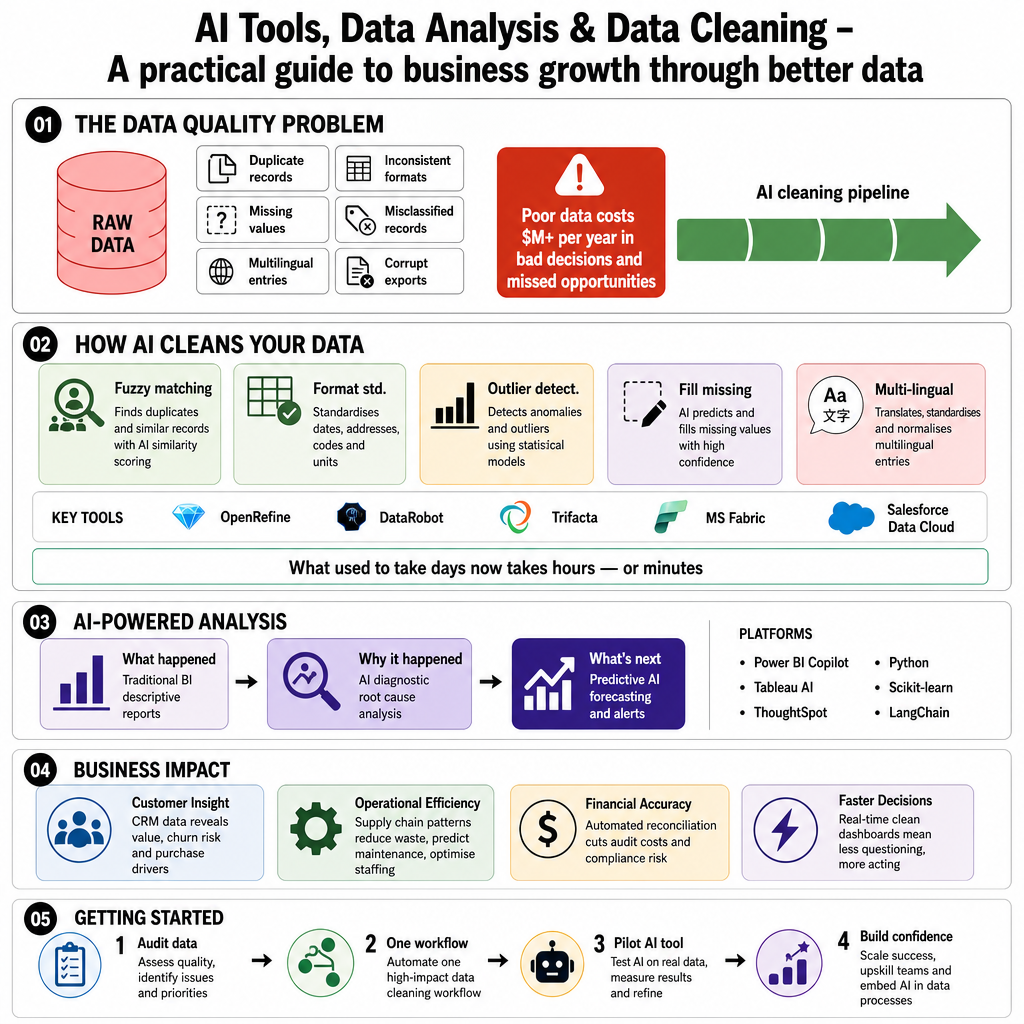
Before any analysis can deliver value, the underlying data must be trustworthy. Poor data quality costs businesses millions each year in flawed decisions, wasted resources, and missed opportunities. Data cleaning—the process of detecting and correcting inaccurate, incomplete, or duplicate records—has traditionally been one of the most time-consuming tasks in any analytics workflow.
Common data problems include duplicate customer entries, inconsistent date formats, missing values, misclassified records, and data entered using multiple languages or regional standards. Left unaddressed, these issues quietly corrupt every report and forecast built upon them.
How AI Is Transforming Data Cleaning
Modern AI tools have dramatically reduced the manual burden of data preparation. Instead of spending hours writing rules to catch every possible error, analysts can now rely on machine learning models that learn patterns within the data and flag anomalies automatically.
Tools such as OpenRefine with AI extensions, DataRobot, Trifacta (now part of Google Cloud), and embedded AI features in platforms like Microsoft Fabric and Salesforce Data Cloud can:
- Detect duplicate records with fuzzy matching, even when names or addresses vary slightly
- Suggest and apply standard formats across inconsistent columns
- Identify outliers that may represent data entry errors or fraud
- Fill in missing values using context from surrounding data
- Translate or standardize multilingual entries
What used to take a data team days now often takes only hours—or even minutes.
AI-Powered Analysis: From Numbers to Decisions
Once data is clean, AI tools unlock a new level of analytical depth. Traditional business intelligence tools showed what happened, but AI-powered analysis increasingly explains why it happened and predicts what will happen next.
Platforms like Power BI with Copilot, Tableau AI, and ThoughtSpot allow business users—not just data scientists—to ask questions in plain language and receive visual, actionable answers. For example, a retail manager can type, ”Which products had the highest return rate last quarter in the Northeast region?” and receive a ranked breakdown in seconds.
For more advanced needs, tools like Python with libraries such as Pandas, Scikit-learn, and LangChain—combined with large language model APIs—allow developers to build custom pipelines that clean, analyze, and narrate data automatically.
Real Business Impact
These practical benefits translate directly into improved business outcomes:
- Customer Insights — Clean, analyzed CRM data reveals which customers are most valuable, who is at risk of churning, and what drives purchasing decisions.
- Operational Efficiency — Identifying patterns in supply chain or production data helps businesses reduce waste, predict maintenance needs, and optimize staffing levels.
- Financial Accuracy — Automated reconciliation and anomaly detection in financial records reduces audit costs and mitigates compliance risks.
- Faster Decision-Making — When data is consistently clean and dashboards update in real time, leadership spends less time questioning the numbers and more time acting on them.
Getting Started: A Practical Path
Businesses do not need to overhaul their entire technology stack to benefit from AI-driven data practices. A realistic starting path includes:
- Audit your current data — Identify the most critical datasets and their most common quality issues.
- Choose one workflow to automate — Start with data cleaning in one department, such as sales or finance.
- Pilot a low-code AI tool — Platforms like Power BI Copilot or Google Looker require minimal technical knowledge and deliver rapid results.
- Build internal confidence — Once teams trust the clean data, appetite for broader AI adoption naturally grows.
Conclusion
AI tools have removed the most significant barriers to effective data use: the extensive time and expertise required to clean and interpret complex datasets. For businesses aiming for sustainable growth, investing in AI-powered data practices is no longer optional—it is one of the clearest paths to making smarter decisions more quickly and with greater confidence.